Kits · Home dishes
Starlink V5 vs V4 (Standard 4 X)
Starlink’s new V5 home dish is smaller, lighter and far less power-hungry than the V4 it sits beside. Here is what changed, from Starlink’s own spec sheets, and why your address usually decides which one you get.
Our pick: the V5 is the better dish on paper for most homes. By our math from Starlink’s spec sheets it has about 52% of the V4’s face area, the dish weighs 62% less, and it draws 47–50% of the power, for the same $349 purchase price. It gives up a little peak hardware speed that only Residential Max could ever reach, and it ships with the smaller Router Mini. But the V5 is “currently available in select areas” and is not meant for in-motion use, so for most buyers the address, not a preference, decides.
Should you get the V5 or the V4?
If your address offers both, get the V5 for a small-to-medium house, an off-grid or solar home, or a windy mounted site; get the V4 for a large house where Router 3’s reach saves a mesh unit. On Starlink’s US list on Nov 4, 2026 both cost $349 to buy, so the choice is about fit, and often your address makes it for you.
The spec sheets side by side
Starlink says “Starlink V4” is Starlink’s customer name for Standard 4 X.
| V4 (Standard 4 X) | V5 | |
|---|---|---|
| Dish size | 594 × 383 × 39.7 mm (23.4 × 15.1 × 1.5 in) | 384 × 306 × 34 mm (15.1 × 12 × 1.3 in) |
| Weight | 2.9 kg (6.4 lb); 3.2 kg (7 lb) with kickstand | dish 1.1 kg (2.4 lb); whole kit 3.8 kg (8.4 lb) |
| Average power | 75–100 W average | 35–50 W average |
| Peak hardware speed | peak hardware speed 375+ Mbps for the V5 vs 400+ Mbps for Standard 4 X (Starlink V4) | |
| Wind | operational in 96 km/h+ (60 mph+) wind | operational in 265 km/h (165 mph) wind when mounted |
| Snow melt | up to 40 mm (1.5 in) of snow melt per hour | up to 40 mm (1.6 in) of snow melt per hour |
| Router in the box | Router 3 (with Standard 4 X): tri-band Wi-Fi 6, rated for 3,200 sq ft and 235 devices, two Ethernet ports | Router Mini (with Standard 4 and V5): dual-band Wi-Fi 6, rated for 2,200 sq ft and 235 devices, two Ethernet ports |
| Price to buy | $349 | $349 |
Both carry an IP67 Type 4 weather rating and have a 110° field of view (Standard 4 X, Standard 4, V5 and Mini). Don’t confuse the V4 with Standard 4: Standard 4 has the same dish size, weight and average power draw as Standard 4 X; it ships with Router Mini instead of Router 3.
Standard (V4)
594 × 383 mm (23.4 × 15.1 in)
75–100 W average
Starlink V5
384 × 306 mm (15.1 × 12 in)
35–50 W average
Starlink Mini
298.5 × 259 mm (11.75 × 10.2 in)
25–40 W average
The weight mix-up in Starlink’s own table
Starlink’s help article comparing the two lists the V4 at 2.9 kg and the V5 at 3.8 kg, which makes the new “lightweight” dish look heavier. It isn’t. The V5 spec sheet gives two weights: the dish alone is 1.1 kg, and 3.8 kg is the whole kit. The V4’s 2.9 kg is the bare dish; its own spec sheet puts it at 3.8 kg (8.3 lb) with kickstand and the 15 m cable.
Compared dish to dish, the V5 is about 62% lighter. Compared kit to kit, they weigh about the same. If you plan to mount the dish on a pole, a fence or a light roof bracket, the dish-only figure is the one that matters.
How much power does the V5 save?
Roughly half. Starlink’s spec sheets, read Nov 4, 2026, rate the V4 at 75–100 W average and the V5 at 35–50 W. At the US average home electricity price that saves about $63–$79 a year by our math, which is small next to the plan, but on solar and batteries it roughly halves the storage the dish needs overnight.
Starlink rates the V4 at 75–100 W average and the V5 at 35–50 W average. Here is our arithmetic on what that means, running all day, every day, at the US average home electricity price of 18.16 cents per kWh (EIA, August 2026):
| Dish | Energy per day | Electricity per year |
|---|---|---|
| V4 (Standard 4 X) | 1,800–2,400 Wh | about $119–$159 |
| V5 | 840–1,200 Wh | about $56–$80 |
On the grid, the V5 saves roughly $63–$79 a year. That’s real but small next to the monthly plan. Off the grid it’s a bigger deal: on a solar-and-battery home, roughly halving the dish’s daily load roughly halves the battery capacity and panel output you need to keep it running through the night and cloudy days.
Is the V5 slower than the V4?
The V5’s peak is about 6% below the V4’s (our math), and Starlink says these are peak speeds based on hardware capability; actual speeds vary and depend on the plan you pick. That’s the key. Residential 100 Mbps is 80–100 Mbps down, 15–35 Mbps up (expected, not guaranteed), and Residential 200 Mbps is 80–200 Mbps down, 15–35 Mbps up (expected, not guaranteed). Both sit far below either dish’s peak. Only Residential Max (up to 400+ Mbps down, 20–40 Mbps up; the Specifications point to the map for local figures) gets near the top, and even there, about 6% of peak is not a difference you’d notice on a stream or a call.
Router: Router 3 vs Router Mini
This is the V4 kit’s one clear advantage. Router 3 is tri-band and covers more floor space; Router Mini is dual-band and smaller (full specs in the table). In a large or long house, the bigger router reaches farther before you need a mesh unit. But the router isn’t welded to the dish: Starlink lists both the V4 and the V5 as compatible with Router 2, Router 3 and Router Mini. A V5 owner who needs more range can add a Router 3 or a mesh node later.
Wind and snow
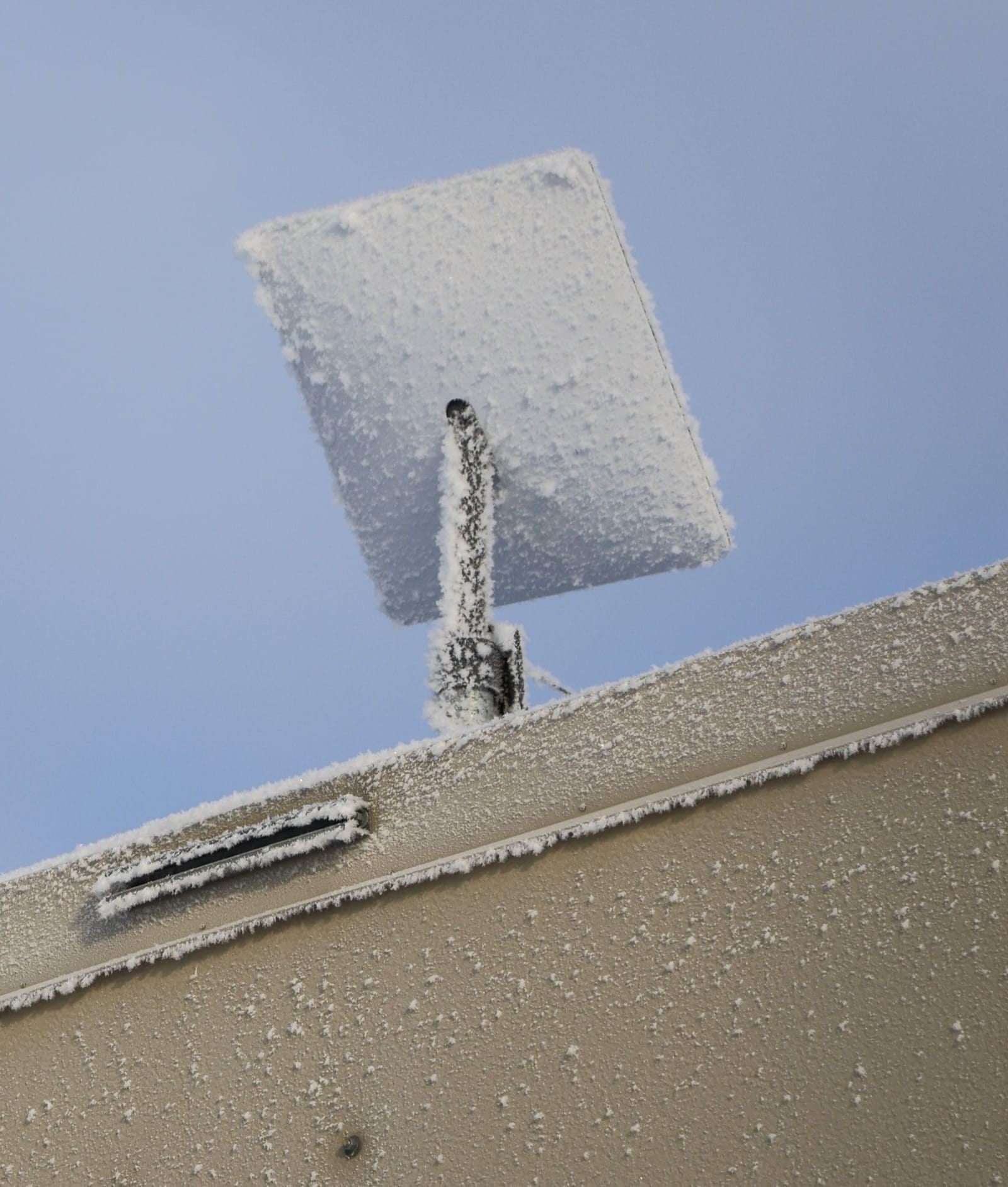
Both melt snow at about 40 mm an hour on paper; the two sheets just round it to different inches. The wind figures look very different, but they aren’t measured the same way: the V4’s 60 mph+ is an open-ended floor, and the V5’s 165 mph is a rating for a mounted dish. Read it as “the V5, properly mounted, is built for high wind”, not as “the V4 gives up just past 60 mph”.
Can you choose? Usually your address does
One more V5 difference: Standby Mode keeps a line paused for a low monthly charge, though select rentals and V5 hardware can’t use it. That doesn’t matter for a year-round main home.
If you’re offered both, pick the V5 for an off-grid or solar home, a windy site where it will be mounted, or a small-to-medium house. Pick the V4 for a large house where Router 3’s range saves you a mesh unit. If neither applies, take whichever your address offers on the better terms; the plan matters more than the dish. Our home plan comparison helps with that part.
More on the V5 and the V4
Is the Starlink V5 faster than the V4?
No. Starlink lists peak hardware speed 375+ Mbps for the V5 vs 400+ Mbps for Standard 4 X (Starlink V4). On Residential 100 Mbps or 200 Mbps your plan caps you well below either peak, so in practice you won’t see a difference.
Should I replace my V4 with a V5?
Not for speed. The V5’s gains are size and power. If you already have Starlink, nothing on this page is meant to sell you anything: for the referral, it’s only for people who have never held a Starlink account.
Does the V5 cost more?
Not on the national list on Nov 4, 2026: the V5 kit was $349 to buy, the same as the V4. Whether you rent or buy at your address is set by Starlink’s offer there.
Sources and checks
Every price and rule on this page was checked against these sources; the oldest check is . Prices move, so starlink.com at your address is always the final word.
- EIA Electric Power Monthly, table 5.6.A (seen Nov 4, 2026)
- Help center: Residential tiers (seen Nov 3, 2026)
- Help center: Standby Mode (seen Nov 3, 2026)
- Help center: the referral program (seen Nov 3, 2026)
- Help center: V4 compared with V5 (seen Nov 4, 2026)
- Spec sheet: Mini (seen Nov 4, 2026)
- Spec sheet: Standard 4 (seen Nov 4, 2026)
- Spec sheet: Standard 4 X (seen Nov 4, 2026)
- Spec sheet: V5 with Router Mini (seen Nov 4, 2026)
- Specifications document, US (seen Nov 3, 2026)
- starlink.com order-page code (our reading) (seen Nov 3, 2026)
- starlink.com Residential order page (US, no address) (seen Nov 4, 2026)
- US referral terms, version of Oct 7, 2026 (seen Nov 4, 2026)